
Introduction
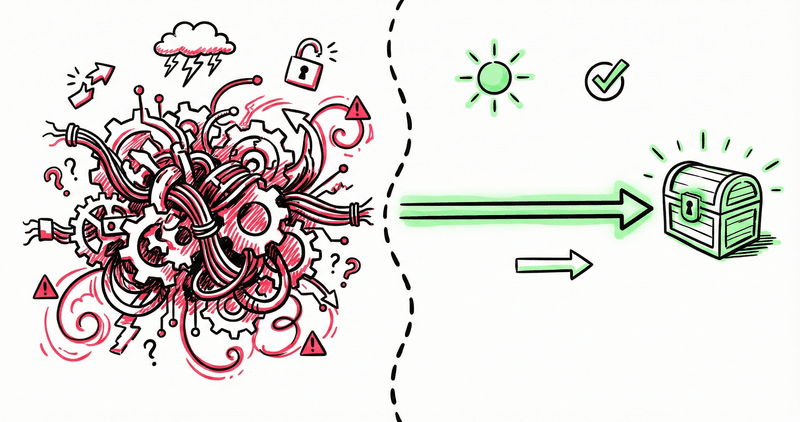
Many indie hackers spend weeks wrestling with OAuth flows, Stripe webhooks, and complex database schemas for a SaaS product that solves a problem nobody actually has. They build the solution, then go looking for the problem.
I've been there. I've spent days perfecting an admin dashboard for a user base of zero. It's a painful, expensive way to learn product development.
Don't do that. The smartest path to your first $1,000 online isn't a complex web application with a recurring subscription model. It's a simple, boring directory.
A directory forces you to focus on the one thing that actually matters in the early days: distribution. You can't code your way out of a marketing problem. But a directory is a marketing asset from day one. It forces you to learn SEO, talk to humans, and understand a niche deeply before you try to sell software to it.
If you're a developer looking for your first win, put down the "Starter Kit" and pick up a list. Let's talk about why curated directories are the ultimate cheat code for bootstrapping your indie hacking career.
The "SaaS" Trap
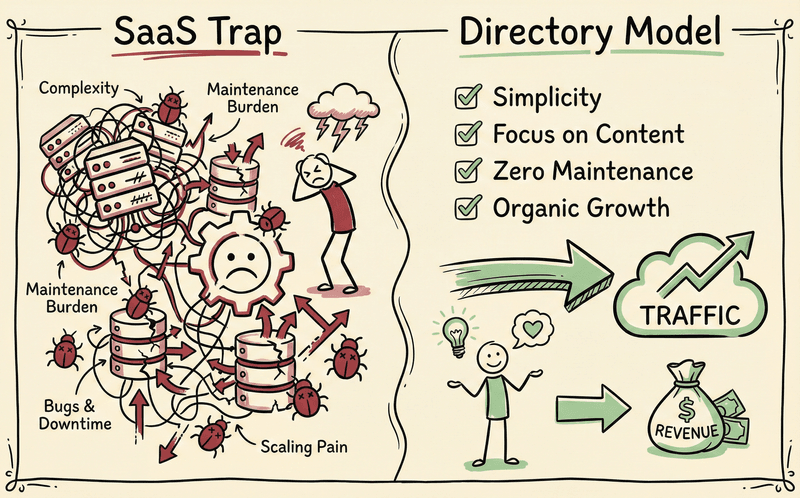
We love SaaS because it feels like real engineering. We get to design database relationships, optimize API endpoints, and build fancy dashboards. It strokes our ego.
But that complexity kills momentum.
When you start a SaaS project, you inherit a mountain of technical debt on day one. You need:
- User authentication (OAuth, magic links, passwords)
- Subscription management (Stripe, Lemon Squeezy)
- Email infrastructure (Transactional, marketing)
- A backend API with CRUD operations
- A frontend dashboard with state management
- Customer support channels for bugs and feature requests
Suddenly, you're not building a business. You're maintaining infrastructure. You spend weeks polishing the login screen before you've even validated if anyone cares.
Compare that to a directory. A directory is essentially a list. It requires almost zero technical overhead. You don't need complex user accounts. You don't need a monthly subscription model that requires handling churn and failed payments. You don't need to worry about scaling a database for thousands of concurrent writes.
A directory is a static asset. Once it's built, it stays built. The maintenance is minimal—adding new listings and keeping data fresh. This frees up 90% of your mental bandwidth to focus on the actual bottleneck: getting traffic.
As indie hackers, we often confuse "hard" with "valuable." Just because SaaS is harder to build doesn't mean it's more valuable to the user. A well-curated list of resources can save someone hours of research. That's value. Don't over-engineer your first dollar.
The Monetization Anomaly
Directories are weirdly profitable. Even with tiny traffic.
With a traditional SaaS, you need users to commit to a monthly subscription. That's a huge friction point. They need to trust your software will solve a complex problem every single day. If they churn, you lose that revenue.
Directories work differently. It feels almost unfair. You serve two masters, but in a good way:
- Users: Looking for answers, tools, or resources. They get value for free.
- Businesses: Looking for leads, exposure, and traffic. They are happy to pay.
You can monetize a directory in multiple ways without needing a sophisticated billing system:
- Featured Listings: Charge businesses a one-time fee to be pinned at the top of a category. Pure profit. It requires zero engineering once the "featured" boolean is in your database.
- Ad Slots: Sell simple banner ads or sponsorship slots. Marc Lou famously sold ad slots on his directories for hundreds of dollars per month with just a Stripe payment link. No ad network integration required.
- Affiliate Links: If you curate software or high-ticket services, you can earn substantial commissions. A single conversion for a $100/month SaaS tool can net you recurring revenue without building the tool yourself.
- Lead Generation: In high-value niches (like legal, real estate, or enterprise software), businesses will pay per lead. A simple "Get a Quote" form can generate thousands in revenue.
The beauty? You don't need thousands of users to make this work. A directory with 500 targeted visitors a month in a specific niche (like "AI tools for lawyers") is infinitely more valuable to advertisers than a generic SaaS with 5,000 free-tier users. You are selling access to intent.
When you build a directory, you aren't just building a product. You're building a media asset. And media assets monetize traffic much faster than software products monetize users.
The Hidden Curriculum (SEO & Niche Mastery)
Building a directory is a crash course in SEO. The kind you can't buy. It forces you to learn the most important skill for any online business: getting organic traffic.
When you build a SaaS, SEO is often an afterthought. You launch, then scramble to write blog posts. But with a directory, the content is the product. Every listing is a potential landing page.
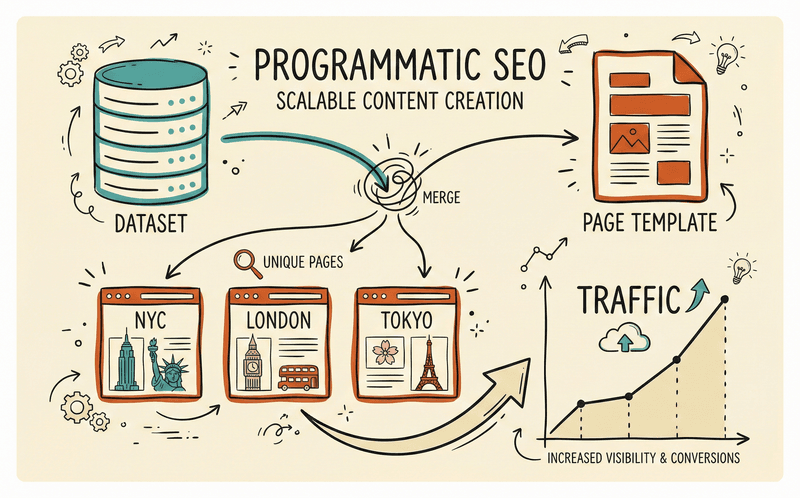
This is where Programmatic SEO (pSEO) kicks in. It's the secret weapon of the big players (TripAdvisor, Yelp, NomadList). Instead of writing 50 articles manually, you learn to generate 500 or 5,000 pages dynamically from a dataset.
Keyword Research: Finding the "Money" Terms
You also learn to distinguish between "vanity" keywords and "money" keywords.
- Vanity: "What is a CRM?" (High volume, low intent). People searching this are students or casual browsers.
- Money: "Best CRM for commercial real estate agents under $50" (Low volume, extreme intent). People searching this have their credit card in hand.
A directory naturally targets these "money" terms. The user intent is "Comparison" and "Selection." By building a directory, you position yourself at the very bottom of the funnel, right before the purchase decision. This is why the traffic is so valuable to advertisers.
The pSEO Architecture
The concept is simple but powerful. You have a dataset (e.g., a list of coffee shops). You identify a search pattern (e.g., "Best coffee shops in [City] with [Feature]").
You don't manually write a page for "Best coffee shops in Portland with WiFi." You build a template:
Title: Best Coffee Shops in {City} with {Feature}
Then your code generates the pages:
/portland/wifi/austin/outdoor-seating/london/specialty-roasts
Suddenly, you rank for hundreds of long-tail keywords. This is how you beat established competitors who are just targeting the head terms.
Deep Niche Mastery
Beyond the technical SEO, a directory forces you to become an expert in a specific niche. Let's say you decide to build a directory for "No-Code tools for Real Estate Agents." You can't just scrape random data. You have to actually understand the landscape.
You learn who the key players are. You discover the specific pain points (e.g., "Why is this CRM so expensive?" or "Which tool integrates with Zillow?"). You start to see patterns in what people are searching for.
For example, you might notice that 40% of searches for "Real Estate CRM" also include the word "iPad."
- Insight: Agents are on the road. They need mobile-first tools.
- Opportunity: Your future SaaS could be a "Mobile-First CRM for Realtors."
This deep domain knowledge is invaluable for your next project. If you decide to build a SaaS later, you will already know exactly what the market needs because you've spent months organizing the existing solutions. You aren't guessing anymore. You have data.
The directory becomes your research lab. You can test demand for different sub-niches just by seeing which categories get the most clicks. It de-risks your future product ideas before writing a single line of complex code.
Learning to "Reach Out"
Most of us developers are natural introverts. The idea of "sales" or "networking" sounds painful. We'd rather refactor code for six hours than send one cold email.
This is the hidden genius of the directory model: it tricks you into doing the uncomfortable work. You can't just build a directory in isolation; you have to fill it. And the best way to fill it is by reaching out to the people you want to list.
Suddenly, "cold outreach" becomes surprisingly easy. You aren't asking for money. You aren't pitching a product. You are offering value.
"Hey [Founder], I'm building a directory of the best [Niche Tools]. I'd love to include [Your Tool] for free. Is this the best link to use?"
That's it. That's the entire pitch. And the response rate is incredibly high because everyone wants free exposure.
This simple interaction teaches you the fundamentals of networking without the fear of rejection. You start building relationships with founders, creators, and influencers in your niche. You get on their radar.
Over time, these "micro-interactions" compound. When you eventually launch a paid product or a premium feature, you aren't launching to a cold audience. You have a list of people who already know you as the person who featured them.
You learn how to find emails, how to write concise messages, and how to follow up. These are the soft skills that separate successful indie hackers from the ones who build in silence. A directory forces you to break out of your IDE and actually talk to the market.
The "Traffic Matrix" Strategy
Think of a directory not just as a product, but as a traffic machine you own. It's a permanent asset that works for you 24/7.
Most indie hackers rely on fleeting traffic sources: a Product Hunt launch that spikes and dies, a viral tweet that lasts 12 hours, or Reddit posts that get buried. These are temporary.
A directory builds long-term, compounding traffic. Once you rank for "Best Notion Templates" or "AI Video Editors," you have a steady stream of high-intent visitors. This becomes your unfair advantage for everything else you build.
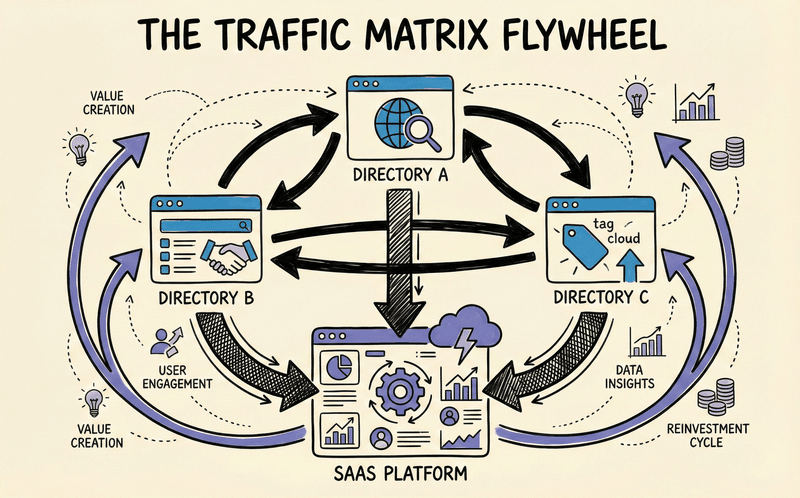
This is the "Traffic Matrix" strategy. Instead of paying for ads to launch your next SaaS, you simply place a banner on your own high-traffic directory. You own the distribution channel.
If you build a directory for "Freelance Tools," and later decide to build a SaaS for invoicing freelancers, you already have the perfect audience visiting your site every day. Your Customer Acquisition Cost (CAC) drops to zero.
You can even build a network of small, interconnected directories. Each one captures traffic for a specific niche and funnels users to the others. This creates a flywheel effect where your total traffic grows faster than the sum of its parts.
This is exactly what successful indie hackers do. They don't just build products; they build ecosystems. A directory is the easiest way to start building that ecosystem because the barrier to entry is so low. It's the foundation of your personal traffic empire.
But Won't AI Kill Directories?
I know what you're thinking. "Why would anyone browse a list when they can just ask ChatGPT?"
It's a valid question. If you're building a generic "List of AI Tools," you might be in trouble. But for niche, curated directories, the AI revolution is actually a tailwind. Here's why.
1. AI Needs a Source of Truth
LLMs are prediction machines, not fact checkers. They need structured, verified data to function. When you build a directory, you aren't competing with AI; you're feeding it.
This is why businesses will still pay you. They know that to be recommended by Gemini or ChatGPT, they need to be in the trusted sources that these models scrape. Your directory becomes the database of record. Listing with you isn't just about human eyeballs anymore; it's about being visible to the algorithms that answer users' questions.
2. Discovery vs. Answers
AI is great at giving you an answer. It's terrible at giving you options. If I ask Gemini "What's the best CRM?", it gives me Salesforce. But if I want to browse "CRMs for freelance designers under $20," I want a list. I want to compare features. I want to see screenshots. I want to explore. Chat interfaces are terrible for browsing.
3. The "Human Verified" Premium
The more AI content floods the web, the more valuable human curation becomes.
We are entering an age of infinite noise. A directory that says "I personally tested these 50 tools" is worth 100x more than an AI-generated list of 5,000 tools. Trust is the scarcity. By acting as the filter, you provide the one thing AI can't: human judgment.
Don't fear the bots. Be the data they desperately need.
Case Study: The Marc Lou Effect
If you need proof that directories can out-earn SaaS, look no further than Marc Lou's TrustMRR.
Marc saw a problem: indie hackers posting fake revenue screenshots on Twitter to go viral. The community was cynical. He didn't spend months building a complex fraud detection AI. He built a simple directory.
He created a site that used the Stripe API to verify revenue. Verified startups got a badge and a listing. That's it. He launched it in under 24 hours.
The results?
- Viral Launch: By solving a timely, specific pain point (trust), he got massive distribution instantly.
- Insane Monetization: Within days, he was selling ad slots on the sidebar. He started at $299/month, then raised prices to $699, $999, and eventually $1,499/month as demand surged.
- Revenue: TrustMRR generated over $20,000 in its first few days. That's more than most SaaS products make in their first year.
Before TrustMRR, Marc had Indie Page, another directory-style product that aggregated startup metrics. It consistently brings in revenue and traffic.
What can we learn from this?
- Speed Wins: He didn't overthink the tech stack. He shipped.
- Utility is Viral: The directory solved a social problem (fake stats) with a technical solution (API verification).
- Monetization is Flexible: He didn't need 1,000 subscribers at $10/mo. He needed a few high-value sponsors who wanted access to his traffic.
This is the power of the directory model. It allows you to capitalize on trends and problems fast. While others were arguing about fake MRR in tweet threads, Marc built the destination for the conversation and monetized it.
Your Weekend Plan
Okay, you're convinced. You want to stop building vaporware and start building an asset. Here is your plan for this weekend:
Friday Night: Niche Selection (2 Hours)
Pick a niche that is expensive and fragmented. Avoid "AI Tools" (too saturated). Look for "Boring" industries where businesses spend money:
- The "Unbundled Craigslist" Strategy: Look at a category on Craigslist or Yelp that feels cluttered. Can you unbundle it? (e.g., "Craigslist for tiny homes" -> TinyHouseListings.com).
- The "Software Integration" Niche: "Notion templates for Students," or "Shopify apps for drop-shippers."
- The "Local Service" Play: "Commercial contractors in Austin," "Wedding venues in Nashville under $5k," or "EV charger installers in London."
Checklist:
- Are there at least 50 potential businesses/tools to list?
- Do these businesses currently spend money on ads (check Google)?
- Is there search volume for "best [niche] in [location]" or "best [niche] tools"?
- Can I curate this better than a generic Google search?
Saturday: Build It (Keep It Stupid Simple) (8 Hours)
Recommended Tech Stack:
- Framework: Next.js, Astro (It ships zero JS by default, perfect for SEO).
- Styling: Tailwind CSS (Fast, consistent).
- Database: A simple JSON file or a Google Sheet (fetched at build time). You do not need a Postgres database for 50 items.
- Hosting: Vercel or Netlify (Free tier).
- Images: Cloudinary (Free tier) for optimized delivery.
Speed Tip: Use Claude to Ship Faster You don't need to hand-code every component. Use Claude/Gemini/Codex to generate your boilerplate. It can write the JSON schema, the responsive grid components, and the search filter logic in seconds. Your job is to assemble the Lego blocks, not manufacture the plastic.
Look, I love Django. I love designing complex backends and API architectures. But for a directory, they are overkill. Stick to simple infrastructure.
Core Pages:
- Home: H1 title with keyword, search bar/filter, grid of featured listings.
- Category Pages:
/category/[slug]. - Listing Detail:
/listing/[slug]with rich descriptions, screenshots, and an external link. - Submit Page: A simple Tally.so form or Google Form embedded.
Your goal is to have a deployable URL by Saturday night. No auth. No payments. Just a list.
Sunday: The "Reaching Out" Sprint (6 Hours)
Spend the entire day finding 50 businesses or tools that fit your directory.
- Data Entry: Add them to your JSON/Sheet. Write a better description than they have on their own site. Make them look good. (Tip: Paste their homepage url into Claude and ask for a "2-sentence benefit-driven summary" to speed this up.)
- Find Contacts: Use LinkedIn or their "About" page to find the founder or marketing lead.
- The "Value First" Email: Or DM on X.com, Reddit, LinkedIn
Subject: Featured you on [Directory Name]
Hi [Name],
I'm building a curated directory of the best [Niche] resources, and I just added [Company Name] to the list.
You can check it out here: [Link to their specific listing]
I wrote a custom description for you based on your homepage. Let me know if you want me to update anything—it's completely free.
Best, [Your Name]
Why this works:
- You aren't asking for anything.
- You've already done the work.
- You are giving them a backlink and potential traffic.
The Ask (Optional):
If they reply saying thanks, you can ask for a small favor: "Glad you like it! If you have a moment, a quick shoutout on Twitter/LinkedIn would be huge for getting the word out."
That's it. You have now launched. You have a product, you have content, and you have potential traffic sources. You are 10x ahead of the indie hacker who spent the weekend configuring AWS.
You've built something real. Now, keep going.
Conclusion
If you're still reading this, you probably feel a mix of excitement and skepticism. "A directory? Really? That's too simple."
Exactly.
The simplicity is the feature, not the bug. The directory model forces you to strip away the technical complexity that usually drowns beginners. It makes you focus on the fundamentals: finding a hungry market, solving a clear problem, and getting traffic.
Stop treating your indie hacking journey like a coding contest. Nobody cares how elegant your backend architecture is if nobody uses it.
Treat your first project as an asset. A directory is a digital real estate play. It's a traffic hose that you own. It's the foundation upon which you can build a massive portfolio of products.
Your directory is your tuition-free MBA in indie hacking. It teaches you everything you need to know about SEO, cold outreach, and monetization without the crushing weight of SaaS support tickets.
So, put down the SaaS idea for now. Open up a spreadsheet. Pick a niche. Start listing.
Your future self—sitting on a steady stream of passive traffic and ad revenue—will thank you.