

Introduction
AI lets us ship features faster than ever, but that doesn't fix the core issue: too many indie hackers are still building SaaS products for problems nobody actually has. They build the solution first, then go looking for a problem.
I've been there. I've spent days perfecting an feature for zero users. It's an expensive, depressing way to learn product development.
If you want to actually make your first dollar online, the most straightforward path is usually something much more boring: a simple directory.
Building a directory forces you to focus on the one thing that actually matters early on: distribution. You can't code your way out of a marketing problem. A directory is just a marketing asset in disguise. It makes you learn SEO, talk to real people, and understand a niche deeply before you try to sell software to it.
If you're stuck looking for your first win, maybe put down the SaaS starter kit and build a list instead.
The "SaaS" Trap
I get the appeal of SaaS. It feels like real engineering. You get to design database relationships, optimize API endpoints, and build dashboards. It's fun.
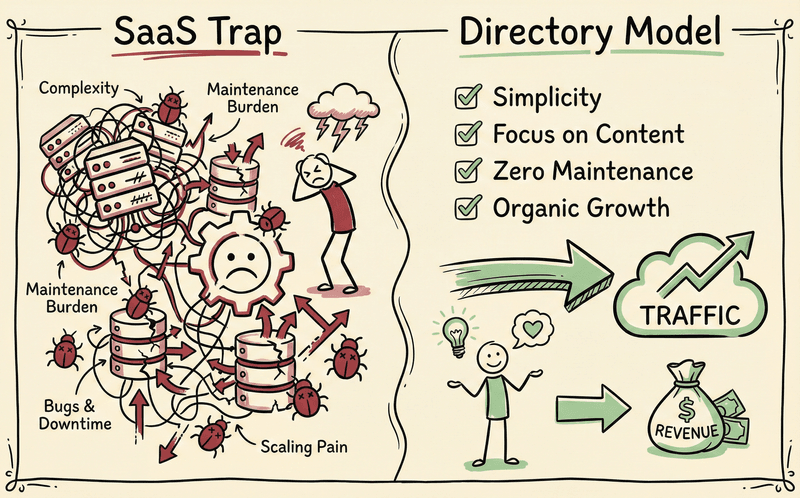
But that complexity is exactly what kills momentum.
When you start a SaaS project, you take on a mountain of technical overhead immediately. You have to set up user authentication, handle subscription management with Stripe or Lemon Squeezy, configure email infrastructure, build an API, and manage state on the frontend. Oh, and you have to handle customer support for bugs.
Instead of building a business, you end up maintaining infrastructure. Sure, AI coding tools have made development incredibly fast today, but that just means you can fall into the complexity trap even quicker: spending hours generating and wiring up auth flows before you even know if anyone actually wants the product.
A directory is essentially just a list. The technical overhead is practically zero. You don't need user accounts, a monthly subscription model, or a database scaled for concurrent writes.
Since a directory is mostly static, maintenance usually just means adding new listings and fixing broken links. This leaves you with actual mental bandwidth to focus on getting traffic.
Developers often confuse "hard to build" with "valuable." A well-curated list of resources can save someone hours of research. People value that. Don't over-engineer your first dollar.
The Monetization Anomaly
Directories can be surprisingly profitable, even with terrible traffic numbers.
With a traditional SaaS, you have to convince users to commit to a monthly subscription. That's a huge friction point. They have to trust your software solves a problem they face regularly.
Directories operate differently. You're connecting two different groups. Users get free value when they look for answers or tools. Businesses are willing to pay because they need leads and exposure.
You can monetize a directory without writing a complex billing system.
You can charge businesses a one-time fee to pin their listing at the top of a category. You can sell banner ads. I know founders who sell ad slots on their directories for hundreds of dollars a month using nothing but a Stripe payment link—no ad networks required.
Affiliate links are another option. If you curate high-ticket software or services, a single conversion can bring in recurring commissions. In high-value niches like real estate or enterprise software, businesses might even pay per lead generated through a basic contact form.
A directory with 500 targeted visitors a month in a specific niche is often more valuable to advertisers than a generic SaaS with 5,000 free-tier users. You're selling access to people with high purchase intent. Building a directory is essentially building a media asset, and media assets tend to monetize traffic much faster than software products monetize users.
The Hidden Curriculum (SEO & Niche Mastery)
Running a directory forces you to learn SEO. Organic traffic is really the only sustainable way they grow.
With a typical SaaS, founders often treat SEO as an afterthought—launching the product first and then frantically trying to write blog posts later. With a directory, the content is the product. Every individual listing is a potential landing page.
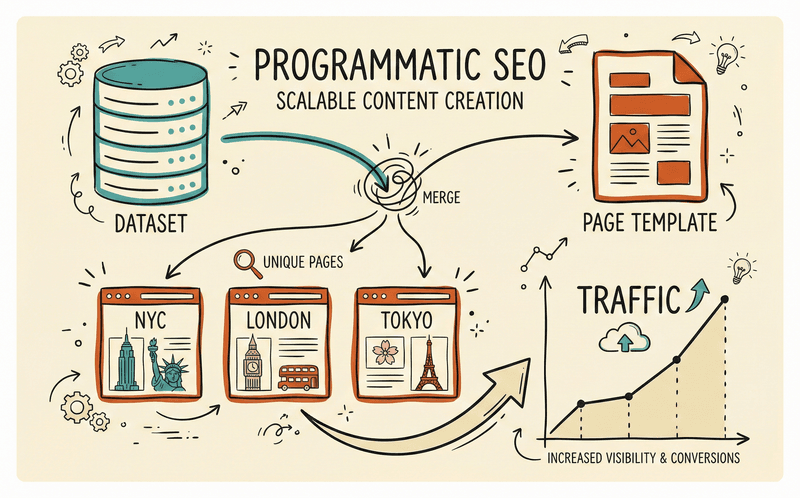
Directories lend themselves well to programmatic SEO. Sites like TripAdvisor or NomadList do this at scale. Rather than writing articles manually, you generate pages dynamically from a dataset.
Keyword Research: Finding the "Money" Terms
Running a directory helps you see the difference between high-volume informational keywords and low-volume transactional ones.
Someone searching "what is a CRM" is probably just browsing. Someone searching "best CRM for commercial real estate agents under $50" has a specific need and high purchase intent.
Directories naturally target these transactional terms because users are in the comparison phase, right before making a decision. That's exactly why advertisers value the traffic.
The pSEO Architecture
The programmatic approach relies on combining a dataset with a search pattern.
If you have a database of coffee shops, you don't write individual pages for every city and feature combination. You build a template: Title: Best Coffee Shops in {City} with {Feature}.
Your code then generates pages for /portland/wifi, /austin/outdoor-seating, and /london/specialty-roasts. You end up targeting hundreds of long-tail keywords that larger competitors might ignore.
Deep Niche Mastery
A directory also forces you to actually understand the niche you're targeting. If you build a directory for real estate no-code tools, you have to look closely at the landscape.
You learn about the popular tools and the common complaints users have. You might notice search patterns—like a high volume of queries for iPad-compatible real estate CRMs—indicating a demand for mobile-first tools in that space.
This research is incredibly useful for future projects. If you decide to build a SaaS later, you have actual data on what the market searches for, rather than just guessing. The directory acts as a low-risk testing ground.
Learning to "Reach Out"
A lot of developers hate sales and networking. Sending cold emails feels intrusive.
But building a directory requires you to fill it with content, which usually means contacting the people you want to feature. This actually makes outreach easier, because you're offering them something instead of asking for a favor.
The message is simple: "Hey, I'm building a directory of niche tools and I'd like to include yours for free. Is this the best link to use?"
The response rate tends to be high since founders rarely say no to free exposure.
These low-stakes interactions help you practice finding contact information, writing concise emails, and following up. You gradually build a network of founders and creators in your niche. If you launch another product later, you have an existing list of contacts who already know who you are.
The "Traffic Matrix" Strategy
A directory can serve as a reliable traffic source over time.
Product Hunt launches or viral tweets give you temporary spikes in visitors. Ranking for terms like "best Notion templates" brings in steady, ongoing traffic.
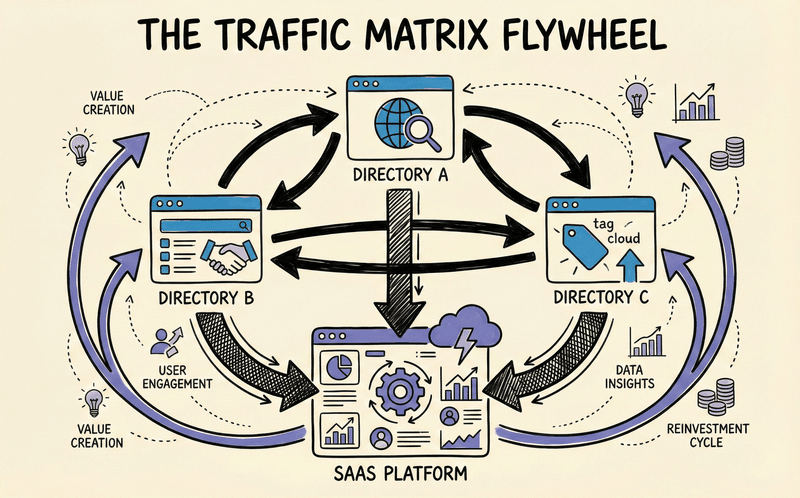
You can use this traffic to promote your other projects. If you run a directory for freelance tools and later build an invoicing app for freelancers, you can just place a banner ad on your own directory. You control the distribution, which lowers your customer acquisition cost to zero.
Some founders build multiple interconnected directories across different niches, linking them together to share traffic. A directory is a low-barrier way to start building an audience that you can eventually direct to future products.
But Won't AI Kill Directories?
I get asked this a lot: "Isn't AI just going to kill directories?"
It’s a fair point. If you can just ask ChatGPT for a recommendation, why scroll through a list?
Honestly, generic lists are probably toast. If you're just dumping "Top 100 AI tools" into a grid, you're competing with a chatbot that's faster and more up-to-date than you. But for niche stuff, directories are actually becoming more important.
1. AI assistants are basically just giant scrapers If you want your tool to show up in a Perplexity or SearchGPT answer, it needs to exist on sites those models trust. A clean, structured directory is the perfect data source for them. In a weird way, building a directory is how you make sure the AI knows your niche exists.
2. Chat handles answers, but it’s terrible for browsing Sometimes you don't want a single answer; you want to look around. Asking a bot for "the best CRM" gives you a wall of text. A directory lets you see screenshots, compare pricing side-by-side, and get a vibe for the software without having to prompt a chatbot five times. It's the difference between a search bar and a showroom.
3. Real curation beats AI sludge every time The web is being flooded with AI-generated junk. When anyone can spin up a site with 5,000 automated listings, a list of 30 tools that a real person has actually tested becomes a huge deal. People are going to crave human "filters" to help them ignore the noise. Trust is going to be a lot more valuable than just having the biggest database.
Case Study: The Marc Lou Effect
Marc Lou's TrustMRR is a good example of how directories can generate revenue quickly.
He noticed people on Twitter were skeptical of founders posting unverified revenue screenshots. Instead of trying to build complex fraud-detection software, he built a directory that used the Stripe API to verify revenue. Startups that verified their numbers got a listing and a badge.
He built the initial version in under 24 hours. Because it addressed a current topic in the community, it received significant traffic right away.
He started selling ad slots on the sidebar for $299 per month. As demand increased, he raised the price in increments up to $1,499 per month. The site generated over $20,000 in revenue in its first few days.
His previous project, Indie Page, was also a directory site aggregating startup metrics.
The TrustMRR launch shows that a simple technical solution can gain traction if it addresses a specific community interest, and that monetization doesn't always require a large volume of low-paying subscribers.
Your Weekend Plan
If you want to try building a directory, here is a rough outline of how to do it over a weekend.
Friday Night: Niche Selection
Try to find a niche where businesses are already spending money, rather than something saturated like "AI tools."
You might look at unbundling a specific category from Craigslist or Yelp, like tiny homes. You could focus on software integrations, such as Notion templates for students. Local services are another option, like commercial contractors in Austin or EV charger installers in London.
Before committing, verify that there are at least 50 potential listings, that businesses in the space are spending money on ads, and that there is search volume for the topic.
Saturday: Build It
Keep the technical stack simple.
Astro or Next.js work well for the frontend, styled with Tailwind CSS. For data storage, a local JSON file or a Google Sheet fetched at build time is usually sufficient for 50 items. You can host it on Vercel or Netlify and use Cloudinary for images.
You can use AI coding tools to generate the code, just tell it what you want, and then give feedback.
You only really need four types of pages: a homepage with a search bar and grid, category pages, individual listing detail pages, and a simple submission form using a tool like Tally.so. Skip authentication and payments for now.
Sunday: The "Reaching Out" Sprint
Spend Sunday finding 50 businesses to include.
Add them to your database and write clear descriptions for each one. Then, look for contact information for the founder or marketing lead via LinkedIn or their website.
Send a brief message letting them know you've featured them.
Subject: Featured you on [Directory Name]
Hi [Name],
I'm putting together a directory of [Niche] resources and included [Company Name].
You can see the listing here: [Link]
I drafted a description based on your homepage. Let me know if you'd like me to change anything—the listing is completely free.
Best, [Your Name]
This approach usually gets a positive response because you're providing a backlink without asking for payment. If they reply, you can optionally ask if they'd be willing to share the link on social media.
By the end of the weekend, you'll have a live site with content and the beginnings of a network in your chosen niche.
Conclusion
Building a directory might seem too simple, but that simplicity is exactly why it works. It removes the technical complexity that often stalls new projects and forces you to focus on finding a market and getting traffic.
Users don't care about the backend architecture if the product helps them find what they need. A directory can serve as an initial asset that brings in traffic, which you can later direct to other projects.
It provides practical experience with SEO, outreach, and basic monetization without the maintenance overhead of a SaaS application. If you've been struggling to get a complex software project off the ground, consider starting with a spreadsheet and a niche list instead.